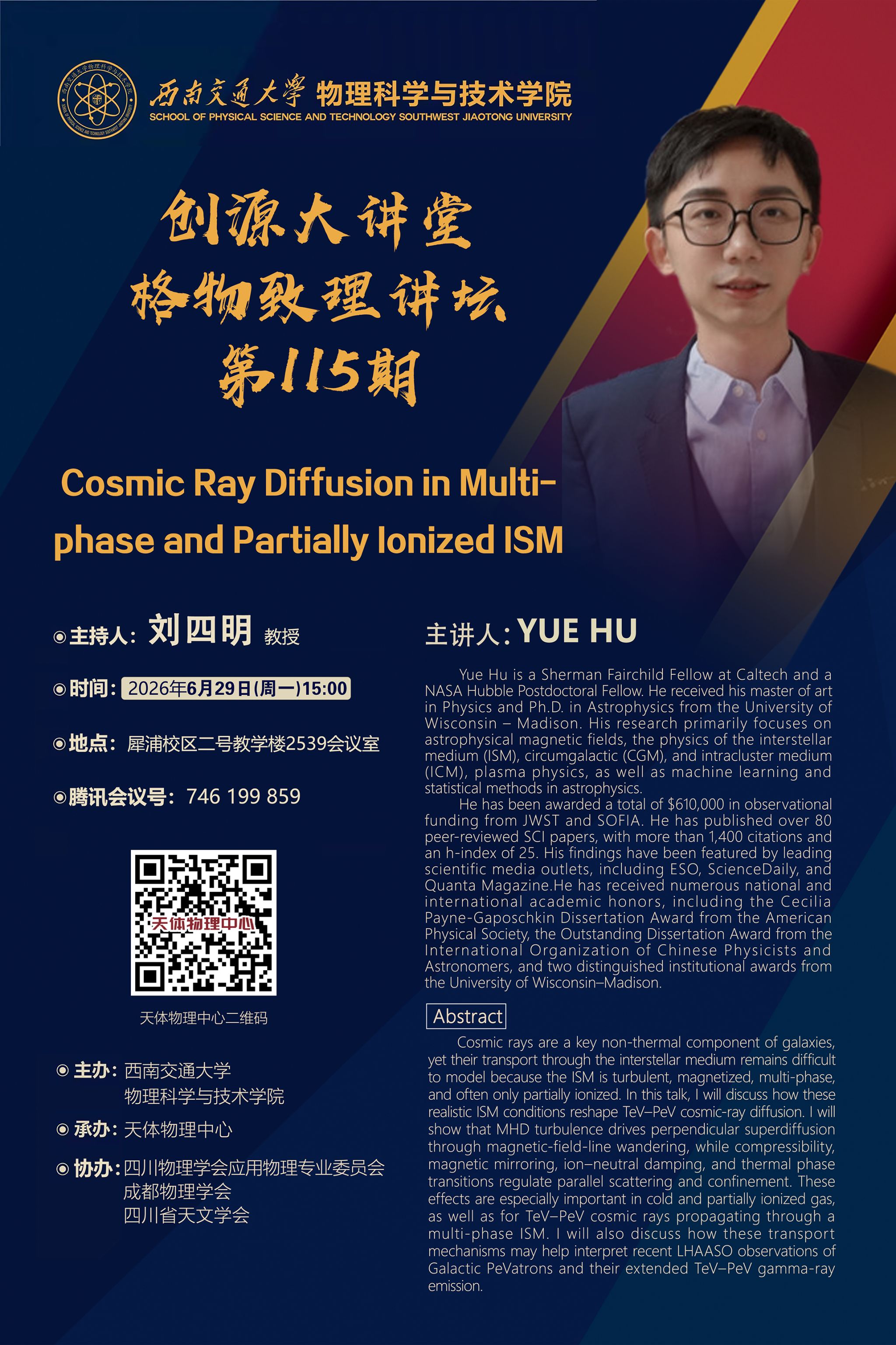
主持人:刘四明教授
时间:2026年6月29日(周一)15:00
地点:犀浦校区二教2539会议室
腾讯会议号:746 199 859
Title: Cosmic Ray Diffusion in Multi-phase and Partially Ionized ISM
主讲人:YUE HU
Yue Hu is a Sherman Fairchild Fellow at Caltech and a NASA Hubble Postdoctoral Fellow. He received his master of art in Physics and Ph.D. in Astrophysics from the University of Wisconsin–Madison.His research primarily focuses on astrophysical magnetic fields, the physics of the interstellar medium (ISM), circumgalactic (CGM), and intracluster medium (ICM), plasma physics, as well as machine learning and statistical methods in astrophysics.
He has been awarded a total of $610,000 in observational funding from JWST and SOFIA. He has published over 80 peer-reviewed SCI papers, with more than 1,400 citations and an h-index of 25. His findings have been featured by leading scientific media outlets, including ESO, ScienceDaily, and Quanta Magazine.He has received numerous national and international academic honors, including the Cecilia Payne-Gaposchkin Dissertation Award from the American Physical Society, the Outstanding Dissertation Award from the International Organization of Chinese Physicists and Astronomers, and two distinguished institutional awards from the University of Wisconsin–Madison.
Abstract: Cosmic rays are a key non-thermal component of galaxies, yet their transport through the interstellar medium remains difficult to model because the ISM is turbulent, magnetized, multi-phase, and often only partially ionized. In this talk, I will discuss how these realistic ISM conditions reshape TeV–PeV cosmic-ray diffusion. I will show that MHD turbulence drives perpendicular superdiffusion through magnetic-field-line wandering, while compressibility, magnetic mirroring, ion–neutral damping, and thermal phase transitions regulate parallel scattering and confinement. These effects are especially important in cold and partially ionized gas, as well as for TeV–PeV cosmic rays propagating through a multi-phase ISM. I will also discuss how these transport mechanisms may help interpret recent LHAASO observations of Galactic PeVatrons and their extended TeV–PeV gamma-ray emission.